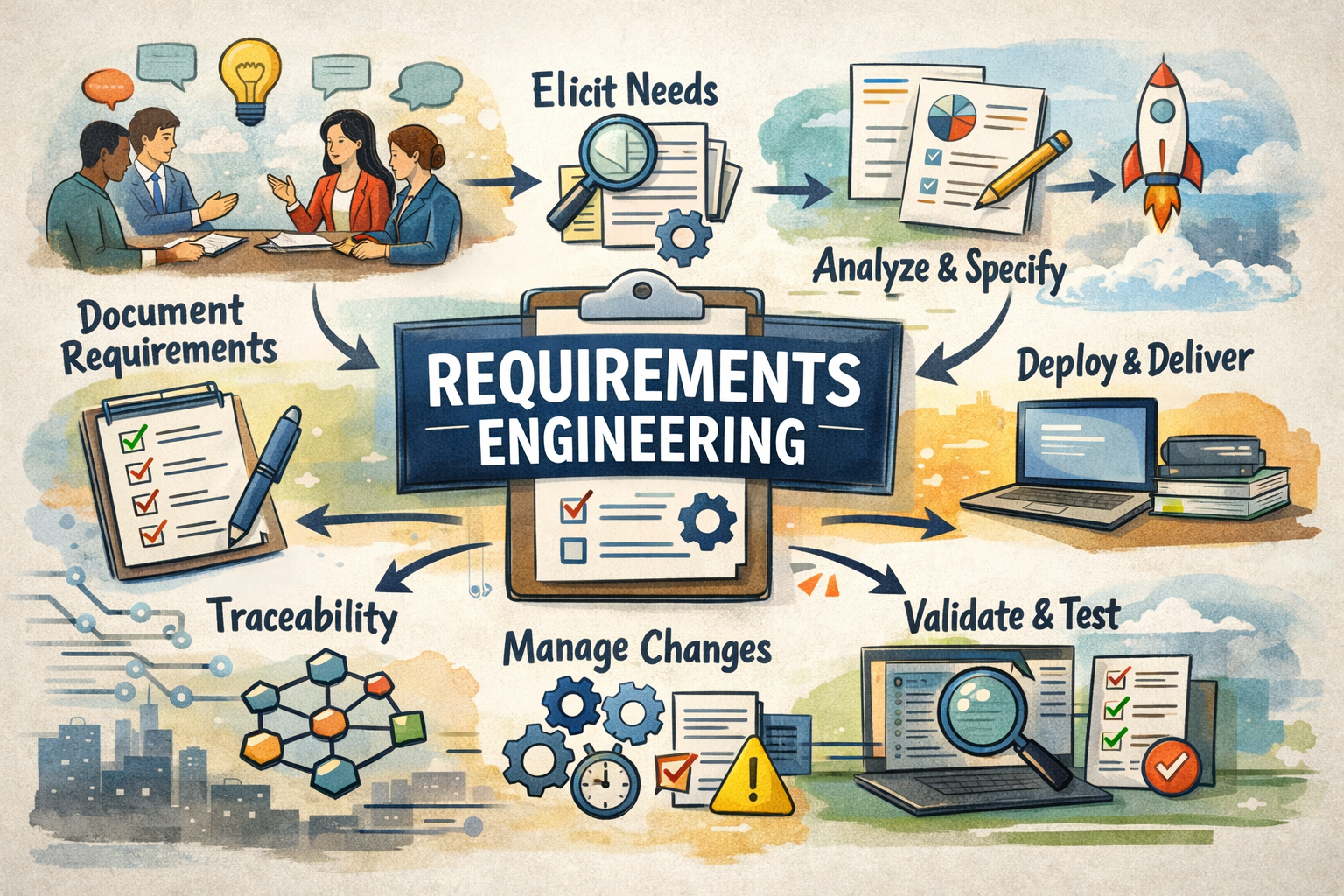
Requirements Engineering Lifecycle
Master the essential stages of requirements engineering that transform stakeholder needs into successful software solutions.
Requirements engineering follows a structured lifecycle that guides projects from initial discovery through successful delivery. Understanding these stages enables Business Analysts to manage complexity, reduce risk, and ensure that development efforts align with stakeholder needs. Each stage serves a distinct purpose, yet they form an integrated process that continues throughout the project.
Requirements Elicitation: Discovering What Stakeholders Need
Elicitation is the systematic process of gathering information from stakeholders to understand their needs, expectations, constraints, and priorities. This stage involves much more than simply asking people what they want. Effective elicitation uncovers both explicit requirements that stakeholders articulate clearly and implicit needs that they assume or cannot easily express. The challenge lies in the fact that stakeholders often describe desired solutions rather than underlying problems. The Business Analyst must probe deeper to understand the actual goal they are trying to achieve, revealing opportunities for better solutions.
Multiple elicitation techniques exist, each suited to different situations:
- •Interviews provide deep insights through one-on-one conversations, working well for understanding individual perspectives and building relationships with key stakeholders.
- •Workshops bring diverse stakeholders together to collaborate, identify common ground, and resolve conflicts early through facilitated sessions.
- •Observation involves watching how users currently work, revealing unstated needs and pain points that stakeholders might not articulate.
- •Prototyping enables stakeholders to interact with tangible examples, clarifying abstract concepts through concrete demonstrations.
- •Questionnaires scale information gathering across large populations when face-to-face interaction is impractical.
- •Document analysis examines existing systems, organizational policies, and regulatory requirements to identify relevant requirements.
Requirements Analysis: Making Sense of What You've Learned
Analysis transforms raw information gathered during elicitation into structured, coherent requirements. This stage involves organizing, categorizing, refining, and prioritizing requirements while identifying conflicts, dependencies, and gaps.
Key analysis activities include:
- •Categorizing requirements into appropriate types such as functional, non-functional, business, stakeholder, and transition requirements.
- •Identifying conflicts between requirements from different stakeholders and facilitating resolution through structured decision-making.
- •Detecting dependencies between requirements that influence project sequencing and implementation approach.
- •Assessing feasibility within project constraints regarding technology, skills, time, and budget.
- •Filling gaps where requirements are incomplete or missing through additional investigation.
- •Modeling requirements using diagrams, workflows, and visual representations to clarify complex specifications.
Prioritization constitutes a critical analytical activity. Techniques such as MoSCoW categorization (Must have, Should have, Could have, Won't have) help teams make systematic decisions about which features to build first, forcing explicit conversations about trade-offs.
Requirements Documentation: Creating Clear Specifications
Documentation produces formal specifications that guide design, development, and testing. These artifacts serve as the contract between stakeholders and the development team, establishing what will be built and how success will be measured.
Effective requirements documentation exhibits several essential characteristics:
- •Unambiguous language that allows only one reasonable interpretation, replacing vague terms with specific, measurable criteria.
- •Completeness that provides all information necessary for implementation without forcing developers to make assumptions.
- •Consistency throughout the document, avoiding contradictions that create confusion.
- •Verifiability that enables objective confirmation of whether the system satisfies each requirement.
- •Traceability that maintains clear relationships between requirements and their sources.
- •Appropriate detail level for the intended audience, balancing clarity with flexibility.
Documentation formats range from traditional specifications to visual models. Use cases describe interactions between users and the system. Process flows illustrate workflows. Data models represent information structures. Interface mockups clarify user experience expectations.
Requirements Validation and Verification: Ensuring You Got It Right
Validation and verification work together to ensure requirements quality before development begins. Validation confirms that documented requirements accurately reflect stakeholder needs and solve the right problems. Verification ensures that requirements are complete, consistent, feasible, and testable. This critical stage prevents costly misunderstandings before significant resources are committed. The cost of correcting requirements defects increases exponentially as projects progress. A specification error discovered during validation might take one hour to correct, while the same error found during testing could require ten to one hundred times more effort to resolve.
Validation and verification employ multiple techniques:
- •Requirements reviews bring stakeholders together to systematically examine specifications, surfacing ambiguities and confirming understanding.
- •Prototypes allow stakeholders to experience proposed solutions, confirming that requirements address actual needs through interactive demonstrations.
- •Test case derivation verifies that requirements are testable by attempting to write test scenarios before implementation.
- •Consistency checks identify logical contradictions between requirements using both automated tools and human review.
- •Feasibility assessments evaluate whether requirements can be implemented within project constraints regarding technology, schedule, and budget.
- •Compliance verification ensures requirements satisfy regulatory, legal, and organizational standards.
- •Stakeholder sign-off provides formal approval that requirements match expectations and are ready for implementation.
Validation often reveals the need for additional elicitation. Gaps in understanding become apparent when stakeholders examine detailed specifications. This iterative refinement continues until stakeholders confirm requirements are complete and correct.
Requirements Traceability: Maintaining the Connection
Traceability establishes and maintains relationships between requirements and other project artifacts throughout the entire lifecycle. This practice creates visibility into how requirements connect to business objectives, design decisions, code modules, test cases, and deployed features. Effective traceability enables impact analysis, supports change management, and ensures nothing gets lost during implementation.
Traceability links flow in multiple directions:
- •Forward traceability tracks requirements through design, code, and testing, ensuring every requirement gets implemented and verified.
- •Backward traceability links requirements to their sources in business needs, stakeholder requests, or regulatory mandates, justifying why each requirement exists.
- •Horizontal traceability connects related requirements across different categories, revealing dependencies and potential conflicts.
- •Bi-directional traceability maintains connections in both forward and backward directions, providing complete visibility throughout the project.
Traceability proves especially valuable during change management. When requirements change, traceability links immediately identify all affected design elements, code modules, and test cases. Teams can assess change impact comprehensively and implement modifications consistently across the entire system. Traceability also supports project monitoring and reporting. Stakeholders can see which requirements have been implemented, which are in progress, and which remain pending. This visibility helps manage expectations and identify bottlenecks early.
Requirements Management: Controlling Change Throughout the Project
Management addresses the reality that requirements evolve throughout the project lifecycle. Change remains inevitable as stakeholders gain understanding, market conditions shift, and technical constraints emerge. Effective management balances stability needed for productive development with flexibility required to respond to legitimate changes.
Key management activities include:
- •Change control processes evaluate proposed modifications, assessing impact on scope, schedule, cost, quality, and risk before approval.
- •Impact analysis examines how proposed changes affect existing requirements, design decisions, implemented code, and test cases.
- •Version control tracks the evolution of requirements over time, documenting each change with rationale, approval, and timestamp.
- •Baseline management establishes formal snapshots of requirements at key project milestones, creating stable foundations for development.
- •Requirements status tracking monitors the state of each requirement through its lifecycle from proposed to deployed.
- •Communication keeps all stakeholders informed about requirements status and approved changes, preventing surprises.
Effective management requires collaboration between Business Analysts, project managers, and change control boards. Together, these perspectives inform decisions about which changes to accept and how to implement them systematically.
The Continuous Cycle
These stages form a continuous cycle rather than a linear sequence. Validation often reveals the need for additional elicitation. Analysis surfaces questions requiring further stakeholder engagement. Management triggers new analysis as changes are proposed. Successful Business Analysts recognize that requirements work continues throughout the system's operational life. Master these stages and the transitions between them to transform requirements engineering from a chaotic struggle into a manageable, repeatable process that consistently delivers successful outcomes.
Related Articles
Understanding User Stories in Agile Development
Learn how user stories transform software requirements by focusing on user needs rather than technical specifications.
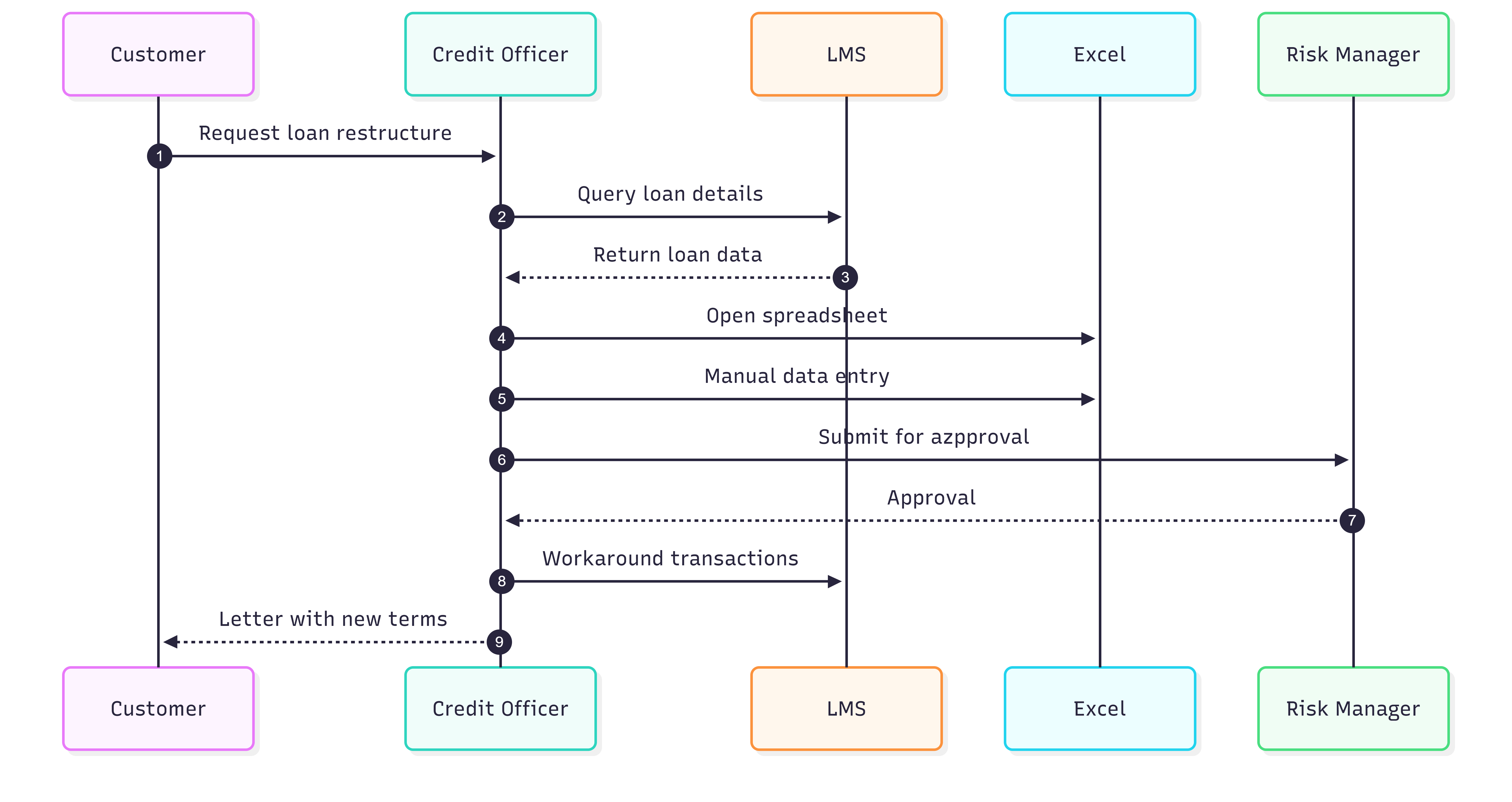
Sequence Diagrams Explained: A Complete Guide with Practical Examples
A comprehensive guide for developers, business analysts, and product managers to understand, create, and master sequence diagrams using Mermaid syntax.
Requirements Engineering Lifecycle
Master the essential stages of requirements engineering that transform stakeholder needs into successful software solutions.